Annual Report
2025-2026
 Dear Friends and Supporters of the UW IDL,
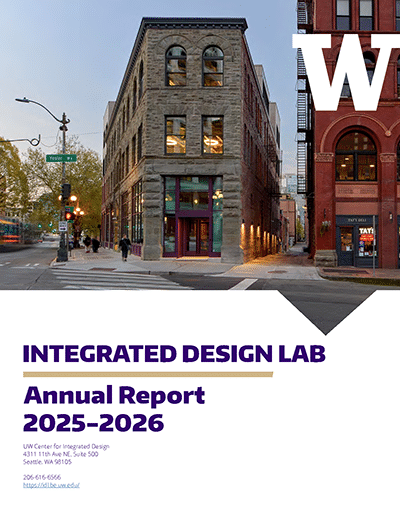
Our cover feature this year is the Metropole Project, a historic building in Seattle’s Pioneer Square. Led by the Satterberg Foundation and architecture firm BuildingWork, the project exemplifies the opportunity for transformational change within our existing building stock. The neglected and fire-damaged 1892 Richardsonian brick building has been re-imagined as a community hub, offering mission-driven organizations affordable office space—all with exceptionally low energy use (18 EUI). The Metropole has been the site of several IDL tours and events this year, showcasing how design and technology can revitalize existing buildings, add value to our communities, and position our region for a more prosperous and energy-efficient future.
We have maintained our emphasis on accelerating the energy transition across the existing building stock. As Washington State enters the first wave of Building Performance Standards (BPS) compliance deadlines and Oregon develops similar requirements, the energy transition of existing buildings no longer a distant objective—it is an immediate challenge and an opportunity to rethink how we invest in, operate, and improve our building stock. The IDL is working to help building owners and industry decision-makers navigate this transition, identify opportunities, and capture the broader value of strategic, long-term investments in building performance.
Central to this effort is preparing the next generation of building industry professionals to understand building operations and conduct performance assessments. After 18 months of operation, we are thrilled to have received continued funding from the U.S. Department of Energy to sustain the Pacific Northwest Building Training and Assessment Center (PNW BTAC) through 2027. This program strengthens our partnerships with South Seattle College, Northwest Indian College, and the UW Industrial Assessment Center. PNW BTAC combines hands-on and virtual building audit training with the development of technical roadmaps for regional building owners, which to-date has included 52 students across 14+ building sites, and over 1,000 hours of onsite assessment activities.
We are also working to make strategic building-performance decisions more accessible. Through our partnership with the Northwest Energy Efficiency Alliance (NEEA), we co-authored a new web-based Building Upgrade Guide to help owners make the business case for holistic capital planning and whole-building energy efficiency.
As part of our R&D work, we have created and shared tools and methods for energy efficiency and decarbonization aimed at underserved building sectors. Notably, IDL partnered with Olson Kundig to develop and release DARA (Decarbonization Analysis for Residential Architecture), a freely available open-source tool that enables practitioners working on small-scale and single-family residential projects to analyze the lifecycle carbon impacts of design decisions. We also published the methodology and results of our work with the Seattle Housing Authority to develop an energy and indoor environmental quality investment decision-making tool for its scattered-site, small-scale residential properties.
We remain deeply grateful to our partners including NEEA, BetterBricks, our Puget Sound utilities, the U.S. Department of Energy, ARPA-E, AIA, ASHRAE, the UW Population Health Initiative, IES, and our Advisory Board for their continued guidance and support. None of this work is possible without our partners.
With Gratitude,
– Christopher Meek and Heather Burpee
Read more in our 2025-2026 Annual Report